
At a glance
The smartest way to evaluate nattokinase is not to chase the biggest mg number.
Start with verified activity, testing transparency, and realistic safe-use boundaries.
Quality comes before marketing.
For an activity-based ingredient, a large mg number does not automatically mean a better product.
Human evidence needs context.
Study outcomes depend on the endpoint measured, the dose used, and the population studied.
Safety is part of quality.
Any product positioned around fibrin-related support should be discussed with clear guardrails, not just bold benefits.
What it is
Nattokinase (NK) is a serine protease enzyme originally identified in natto (fermented soybeans). It is studied primarily for fibrinolytic activity (fibrin-related processes).
In supplements, potency is typically expressed as FU (fibrinolytic units)—a measure of activity, not simply ingredient weight.
Why it matters
Nattokinase is an activity-driven ingredient.
Two products may both say “nattokinase,” yet differ meaningfully in activity if FU verification and stability are not controlled.
Evidence should be read with discipline.
Biomarker changes may be meaningful, but they do not automatically translate into long-term outcomes across every population.
Safe-use boundaries are part of product quality.
A credible nattokinase discussion should include not only what the ingredient is used for, but also who should approach it carefully.

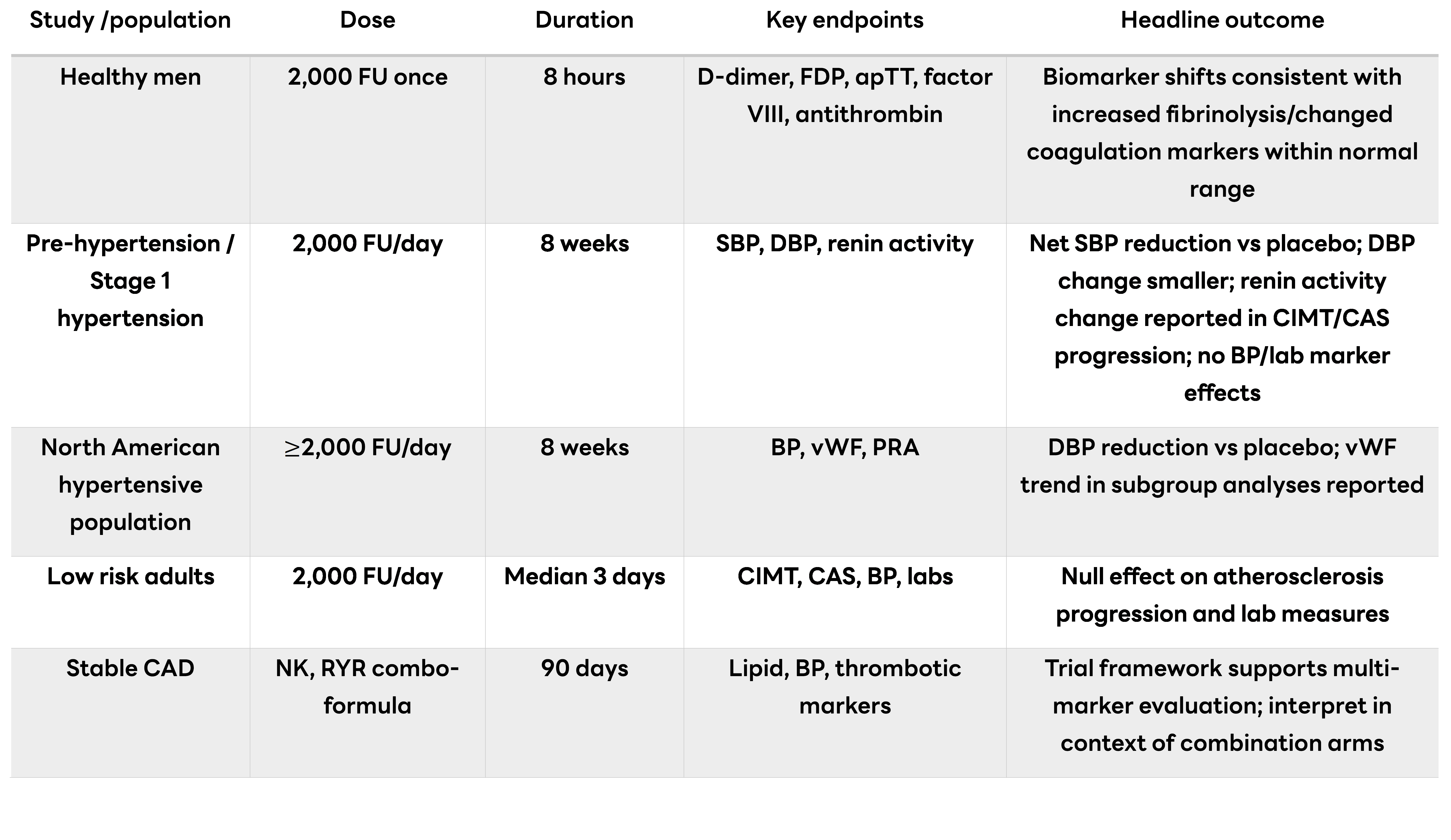
What the Evidence Shows So Far
How to read this without over-claiming
.Short-term biomarkers ≠ clinical outcomes. .Population risk level matters. .Dose reporting must be normalized to FU.
Acute shifts (hours) are not proof of long-term event reduction.
A null result in low-risk adults does not automatically negate potential effects in other groups; it does set expectations for primary prevention claims.
When papers report mg extracts, confirm FU standardization before comparing apples to apples.
Mechanism
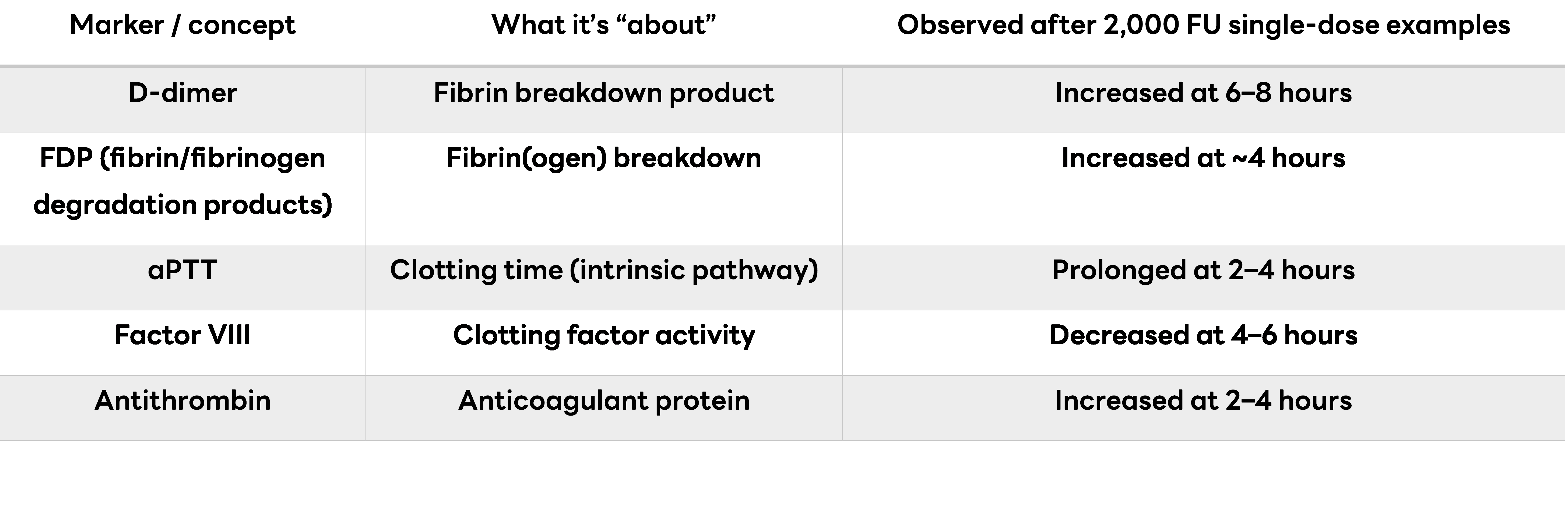
NK intake → Fibrinolysis-related marker shifts (e.g., D-dimer/FDP) → Coagulation balance marker shifts (e.g., aPTT, factor VIII, antithrombin) → potential downstream relevance for vascular health (endpoint-dependent)
Biomarker-to-meaning table
Quality essentials
FU first (not mg)
Choose products that clearly state FU per serving
Avoid labels that emphasize mg while hiding activity metrics
Verification
Request or publish COA /third-party testing: Activity (FU), micro, heavy metals, and lot-to-lot consistency.
Confirm standardization method where possible for assay transparency.
Stability and handling
Enzymes are inherently sensitive — check storage conditions, shelf-life, and stability statements.
Avoid “overpromised” delivery claims unless supported with clear data (formulation differences may exist).

Who should be careful
Nattokinase is not appropriate for all individuals.
Use should be approached cautiously, or avoided unless guided by a clinician, in the following contexts:
.Concurrent use of anticoagulants or antiplatelet medications
.Known bleeding disorders
.Upcoming surgery or invasive procedures
.Pregnancy or breastfeeding
.Pediatric populations
.Soy allergy or sensitivities related to natto-derived products
These considerations are part of responsible use, not exceptional cases.
FAQ
Q: What does FU mean? And why should it matter more than mg?
A: FU = fibrinolytic units, a way to express enzyme activity of nattokinase. A 2,000 FU dose at its minimum is frequently used in human studies.
Q: How do I choose a quality nattokinase supplement?
A:
(1) Label basics:
1. FU clearly stated per capsule/serving
2. Clear serving instructions and storage guidance
(2) Proof
1. COA or third-party testing (activity, contaminants, consistency)
2. Transparent standardization to FU (avoid “trust me bro” labeling)
(3) Stability
1. Shelf-life clarity
2. Stability / lot-to-lot consistency statements where available
Q: Is eating natto the same as taking a nattokinase supplement?
A: Not equivalent. Natto is a whole food matrix; supplements standardize a specific enzyme activity. If you need predictable activity, supplements are the standardized route; if you want dietary tradition + broader nutrition, natto is the classic.
Q: Does nattokinase “thin blood”?
A: A single-dose human study reported shifts in fibrinolysis/coagulation markers (e.g., D-dimer, aPTT). but that’s not the same as being a prescription anticoagulant. Still: don’t mix casually with blood thinners.
Q: Is nattokinase linked to blood pressure support?
A: An 8-week RCT in pre-hypertension/stage 1 hypertension reported SBP/DBP reductions vs placebo. Another RCT in a North American hypertensive population reported DBP reduction vs placebo and exploratory marker changes (e.g., vWF trends in subgroup analyses). Interpret as supportive but not definitive, and always evaluate study design and population fit.
Q: What does the long-term evidence say?
A: A large, long-duration RCT (median 3 years) in low-risk adults found a null effect on subclinical atherosclerosis progression (CIMT/CAS) and laboratory measures. This sets a realistic ceiling for primary-prevention outcome expectations in similar populations.
Q: Nattokinase vs. lumbrokinase vs. serrapeptase — what’s the difference?
A: Same “enzyme supplement” category, different sources + evidence base. NK is natto-derived and has specific coagulation/fibrinolysis biomarker data in humans; cross-product comparisons are messy because units aren’t standardized across enzymes (FU, LKU, U), and claims often outrun evidence.

Q: Best time to take nattokinase?
A: Many protocols position fibrinolytic enzymes away from heavy meals (to avoid “digesting your lunch first”), but follow the specific product guidance and your clinician’s advice if you’re on meds. (Yes, your stomach has a priority queue.)
Q: Can I take nattokinase with red yeast rice (RYR)?
A: There are trials evaluating NK + RYR in CAD contexts; safety reporting exists within the trial framework, but personal use should factor medications, liver markers (for RYR), RYR specifications and clinician oversight.
Q: Fiber-maxxing + psyllium: can I take psyllium with nattokinase?
A: Fiber-maxxing and psyllium is trending as “increase fiber for cholesterol /or metabolic goals,” but don’t speed-run it. Psyllium can interfere with absorption timing for certain meds/supps; A conservative, operations-friendly approach is to separate psyllium from key meds/supps by a few hours when relevant, and increase fiber gradually with adequate fluids, hydration is important!
Related Reading
More details of nattiase® and nattokinase’s selection:
Nattokinase beginner’s guide
Beginner’s guide: choosing a quality nattokinase supplement
References
Published references
Kurosawa et al., 2015, Scientific Reports, A single-dose of oral nattokinase potentiates thrombolysis and anti-coagulation profiles. DOI: 10.1038/srep11601
Kim JY et al., 2008, Hypertension Research, Effects of nattokinase on blood pressure: a randomized, controlled trial. DOI: 10.1291/hypres.31.1583
Hodis et al., 2021, Clin Hemorheol Microcirc, Nattokinase atherothrombotic prevention study: A randomized controlled trial. DOI: 10.3233/CH-211147
Liu Man et al., 2024, Frontiers in Nutrition, Lipid-lowering, antihypertensive, and antithrombotic effects of nattokinase combined with red yeast rice in patients with stable coronary artery disease: a randomized, double-blinded, placebo-controlled trial. DOI: 10.3389/fnut.2024.1380727
Weng et al., 2017, Int. J. Mol. Sci., Nattokinase: An Oral Antithrombotic Agent for the Prevention of Cardiovascular Disease. DOI: 10.3390/ijms18030523
Psyllium safety + spacing reference (NIH/NLM MedlinePlus)
Related Articles

Essentials of Nattokinase
2026-04-20
What Causes Plaque Buildup? Understanding LDL, Triglycerides, and Where Nattokinase Fits
Plaque buildup is not just about “high cholesterol.” Learn how LDL, triglycerides, endothelial stress, and chronic inflammation shape atherosclerosis, and where nattokinase becomes relevant.
Read More
Essentials of Nattokinase
2026-05-18
What is metabolic health? Understanding glucose, lipids, and circulation
A clear framework of metabolic health, connecting glucose, lipids, circulation, and early metabolic imbalance.
Read More