
At a glance
- Brain fog is a symptom cluster, not a diagnosis.
- A more useful way to understand it is through a neurovascular lens: the brain depends on well-regulated blood flow and oxygen delivery to stay clear and efficient.
- This does not mean every case of brain fog is caused by poor circulation, but cerebral blood flow belongs in the conversation.
- Nattokinase is relevant here because it has vascular relevance, not because it acts like a stimulant or a classic nootropic.
- Preclinical findings can support scientific interest, but they should not be turned into human cognition claims.
What it is
“Brain fog” is a broad, informal term people use to describe experiences such as mental slowness, poor concentration, forgetfulness, cognitive fatigue, and reduced mental clarity. That wording matters because brain fog is not a formal diagnosis. It is a symptom cluster, and that distinction should shape how the topic is discussed from the very first paragraph. Rosenberg et al. described brain fog as an undefined term associated with fatigue and impaired memory, attention, and concentration, rather than a stand-alone disease label.

A neurovascular framework gives that conversation a more stable scientific base. The brain does not only need blood flow in a general sense. It needs the right amount of blood flow at the right time. In plain language, neurovascular coupling refers to the brain’s ability to increase local blood flow when a region becomes more active, so oxygen and glucose can reach tissue that is working harder. That is why this article uses the language of cerebral circulation, oxygen delivery, and neurovascular health instead of treating mental clarity as a vague wellness promise.
Why it matters
The brain is highly energy-dependent. Even subtle changes in cerebral blood flow, vascular responsiveness, or oxygen delivery can matter because neural tissue has limited tolerance for supply-and-demand mismatch. Review and imaging literature in aging populations links cerebral hemodynamics and oxygen-related physiology to aspects of cognitive performance and brain integrity.
This does not mean poor circulation explains every case of brain fog. Brain fog can appear in sleep disorders, post-viral states, mood disorders, fatigue syndromes, and other conditions. But it does mean the social-media version of brain fog is often too narrow. A person may experience slower thinking or reduced mental clarity even before anyone uses a formal neurological label, and one overlooked part of that picture is whether the brain’s vascular support system is keeping up.
That is also where nattokinase becomes relevant. Its relevance here is not that it works like coffee or a classic nootropic. Its relevance is that it has been studied in vascular and fibrinolysis-related contexts, and those pathways matter whenever cerebral circulation and neurovascular health enter the conversation. nattiase®’s current internal direction also points to neuro-cells, MCAO rat models, antioxidative signaling, and inflammatory markers, but those remain supportive preclinical context rather than human cognition proof.
What the evidence says
A neurovascular perspective is most useful when the evidence is read in layers. Brain fog itself is not a diagnosis, so the goal is not to force one cause onto a broad symptom cluster. Instead, the literature helps establish three separate but related points:
- What brain fog is.
- Why cerebral blood flow is relevant to cognitive function.
- Where nattokinase may enter the conversation without overstating what current data can support.
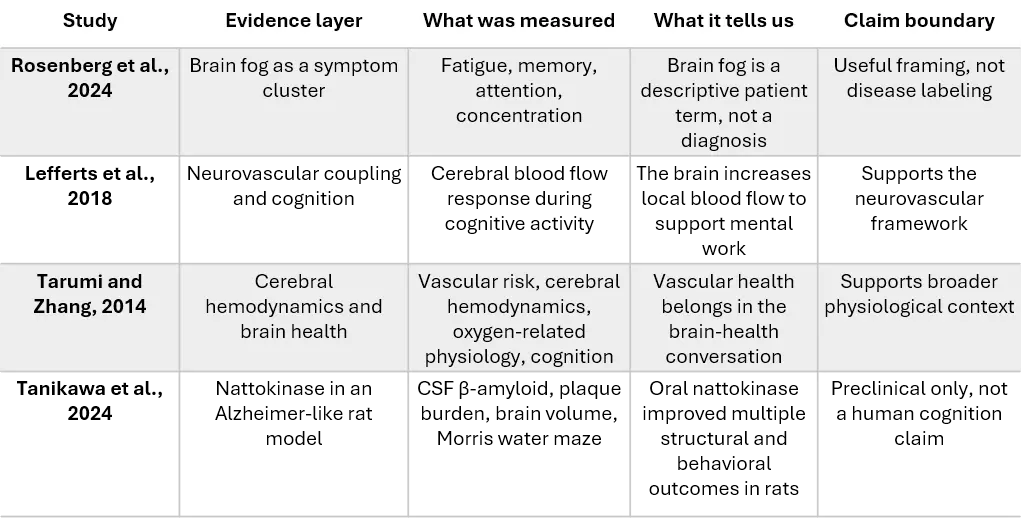

The practical conclusion is that nattokinase can be discussed in a brain-health article when the framing is neurovascular. It should not be framed as a human-proven solution for brain fog, Alzheimer’s disease, or general cognitive enhancement.
Mechanism
A simple way to explain the mechanism is to begin with demand. When mental effort rises, the brain needs more oxygen and glucose. In a well-functioning system, local blood flow rises with that demand. That helps neurons maintain efficient signaling and supports the conditions under which clear thinking is possible. When vascular responsiveness is less efficient, support may lag behind need, and the earliest experience may not look dramatic. It may simply feel like slower thinking, reduced concentration, or a vague sense of mental fog.
Conceptually, the flow looks like this:
- Mental effort rises.
- Oxygen and glucose demand rises.
- Local blood flow should increase.
- Active tissue receives support.
- Mental clarity is better supported.
The reason nattokinase becomes relevant is not because it stimulates the brain directly. It becomes relevant because this article is not using a stimulant framework. It is using a neurovascular one. That distinction is what keeps the article educational, commercial, and scientifically controlled at the same time.
Who should be careful
Anyone with persistent, worsening, or function-limiting brain fog should be careful about treating it as a casual wellness issue. Because brain fog is a symptom cluster rather than a diagnosis, it can overlap with sleep-related disorders, mood disorders, post-viral states, medication effects, metabolic issues, and other medical causes. A responsible article should acknowledge that range instead of implying that one mechanism explains everything.
Readers should also be careful not to overread the nattokinase discussion. A neurovascular framing does not prove that nattokinase improves brain fog in humans. It does not justify Alzheimer’s claims, dementia claims, or broad cognition-enhancement claims. Standard caution also still applies in people with bleeding risk or those using anticoagulant or antiplatelet therapy. Internal product-specific support should remain clearly labeled as proprietary and preclinical.
FAQ
Q: Is brain fog a diagnosis?
A: No. Brain fog is better understood as a symptom cluster. It describes experiences such as fatigue, impaired memory, poor attention, and reduced concentration, but it is not a diagnosis on its own.
Q: Does brain fog mean poor brain blood circulation?
A: Not necessarily. Brain fog is a subjective experience, while reduced cerebral circulation is one possible contributing mechanism among many. The value of a neurovascular framework is that it puts blood flow and oxygen delivery back into the discussion without pretending they explain every case.
Q: Does nattokinase improve brain fog?
A: That claim would go too far. The evidence is stronger for vascular relevance and for preclinical brain-related findings than for direct human brain-fog relief.
Q: Can the Alzheimer-like rat study be mentioned?
A: Yes, but only as preclinical evidence. It may support scientific interest in brain-related research, but it should not be converted into a human Alzheimer’s claim, a dementia claim, or proof of improved memory in people.
Q: Is nattokinase a stimulant or a classic nootropic?
A: No. That is not the right frame for this article. Its relevance here is neurovascular, not stimulant-like. The nootropics category itself is also broad and heterogeneous, which is one reason it is better not to force nattokinase into that label.
Internal links
- Readers who want a broader introduction to this topic can continue with A Natural Secret for Cognitive Enhancement and Brain Health, which works as the broad brain-health spoke.
- For the most direct support around circulation and cognition, Brain Fog Breakdown: How Sluggish Blood Flow Impacts Cognition is the closest spoke to this pillar.
- For preclinical evidence only, Nattokinase Eases Alzheimer-Like Damage in Rats is the appropriate animal-study follow-up.

References
- Rosenberg R, Thorpy MJ, Doghramji K, Morse AM. Brain fog in central disorders of hypersomnolence: a review. J Clin Sleep Med. 2024;20(4):643-651. doi:10.5664/jcsm.11014.
- Lefferts WK, DeBlois JP, Barreira TV, Heffernan KS. Neurovascular coupling during cognitive activity in adults with controlled hypertension. J Appl Physiol (1985). 2018;125(6):1906-1916. doi:10.1152/japplphysiol.00100.2018.
- Tarumi T, Zhang R. Cerebral hemodynamics of the aging brain: risk of Alzheimer disease and benefit of aerobic exercise. Front Physiol. 2014;5:6. doi:10.3389/fphys.2014.00006.
- Tanikawa T, Yu J, Hsu K, Chen S, Ishii A, Kitamura M. Effect of Nattokinase in D-galactose- and Aluminum Chloride-induced Alzheimer's Disease Model of Rat. In Vivo. 2024;38(6):2672-2679. doi:10.21873/invivo.13744.
Related Articles

Understanding the Facts
2025-12-24
Healthy Aging Checklist: Lifestyle Factors That Protect Your Vessels
Protect your vitality from the inside out. Discover the essential Healthy Aging Vascular Checklist covering diet, movement, and screenings to keep your veins and arteries young and resilient. Start your journey to better circulation today.
Read More
Understanding the Facts
2025-12-31
Inflammation vs. Oxidation: Twin Threats to Vascular Health Explained
Learn how chronic inflammation and oxidative stress damage the endothelium, reinforce each other, and accelerate vascular aging—plus practical levers that matter.
Read More