
Essentials of Nattokinase
2026-02-19
Blood Flow & Thrombosis Fundamentals: How Circulation Works and Where Nattokinase Fits
At a glance
Blood flow is one of the body’s most essential systems. It delivers oxygen and nutrients to tissues, supports organ function, and helps remove metabolic waste. Thrombosis becomes relevant when a clot forms inside a blood vessel or the heart and disrupts that flow. These two topics belong together because one describes a vital physiological function, while the other describes one of the most important ways that function can fail.
Nattokinase is relevant to this discussion because it has been studied in relation to fibrinolysis, clotting-related biology, and vascular support. Human studies suggest biological relevance, but the current evidence does not justify presenting nattokinase as a proven stand-alone intervention for thrombosis prevention or stroke prevention.
This article is educational. It is not a substitute for medical diagnosis, emergency care, or prescribed treatment. Symptoms of stroke, deep vein thrombosis, pulmonary embolism, or other acute vascular events require urgent medical evaluation.
What blood flow and thrombosis are
Blood flow refers to the continuous movement of blood through arteries, capillaries, and veins. Its role goes well beyond simply “keeping circulation going.” It supports oxygen delivery, nutrient transport, hormone signaling, immune defense, and waste removal. When circulation is reduced, tissues may not receive what they need to function normally.
Clotting, by contrast, is a normal protective response after injury. Thrombosis is different. It refers to a clot forming inside a blood vessel or the heart where it can partially or completely obstruct circulation. If part of that clot breaks away and travels elsewhere in the body, it becomes an embolus. Depending on where the blockage occurs, the consequences may affect the lungs, the limbs, the heart, or the brain.
Nattokinase is a serine protease enzyme derived from natto, a traditional fermented soybean food. In supplements, its potency is commonly expressed in FU (fibrinolytic units), which reflect enzyme activity rather than ingredient weight alone. This is one reason nattokinase is discussed in relation to blood flow and thrombosis fundamentals rather than as a generic wellness ingredient.
Why it matters
Healthy circulation matters because every organ depends on reliable blood flow. When circulation becomes less efficient, the earliest signs may seem minor, such as numbness, cold extremities, reduced walking tolerance, or slower healing. But the underlying issue is not always minor. In some cases, these changes reflect broader vascular stress or reduced tissue perfusion.
Thrombosis matters because it can turn a normal clotting response into a vascular emergency. A clot in a deep vein can travel to the lungs. A clot blocking an artery can reduce oxygen delivery downstream. In the brain, blocked blood flow can cause ischemic stroke. That is why thrombosis belongs at the center of any serious blood-flow discussion.
This is also why nattokinase appears so often in this topic area. When blood flow is discussed together with clot-related pathways, fibrin turnover, and vascular support, nattokinase stands out more clearly than a generic circulation ingredient. That relevance is supported by published review literature and by human marker studies that connect nattokinase to coagulation-related biology.
What the evidence says
The most balanced way to describe the evidence is this: nattokinase is mechanistically relevant, supported by human biomarker data and broader cardiovascular-risk discussion, but not yet established as a proven stand-alone intervention for thrombosis prevention or stroke prevention.
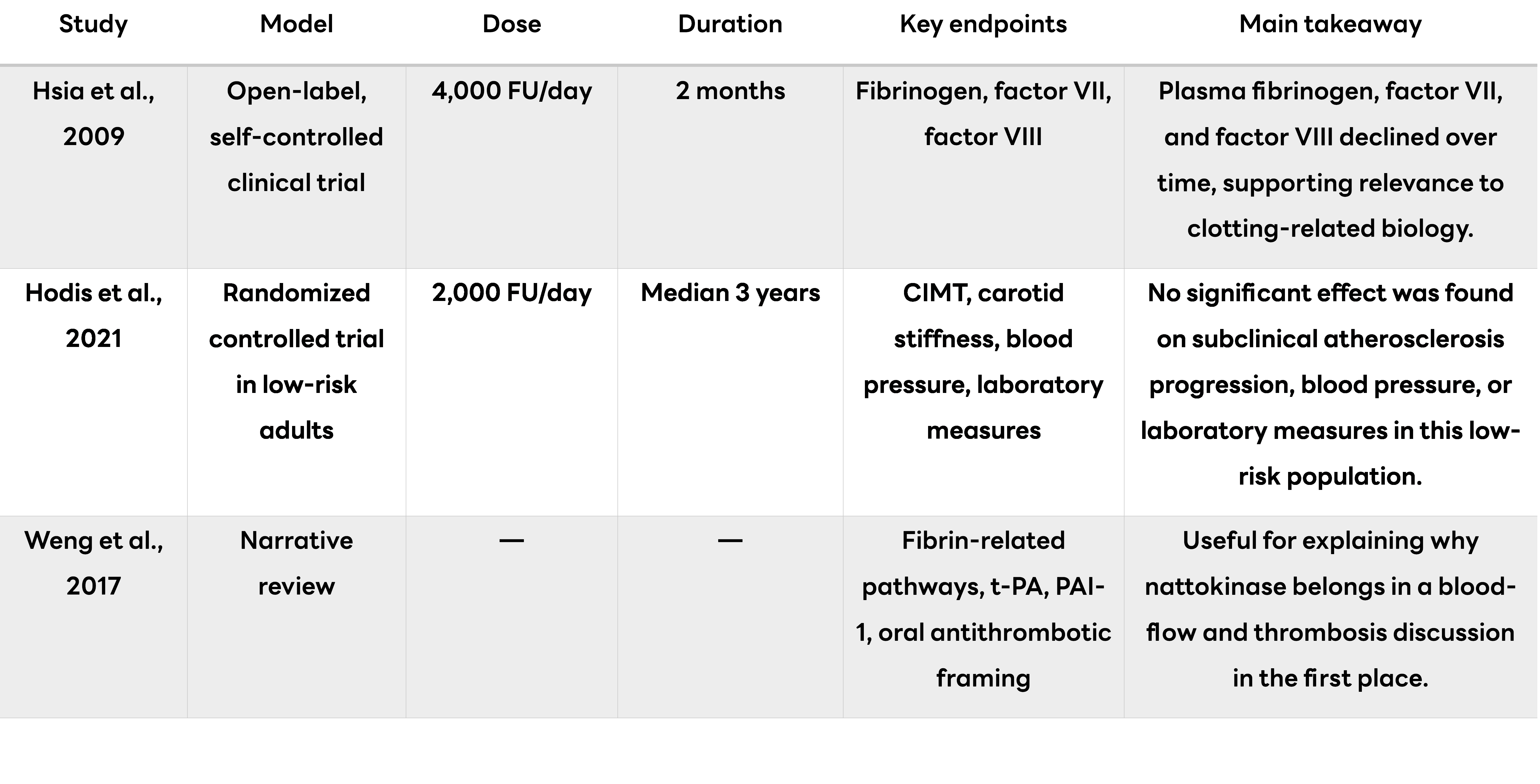
Taken together, these findings suggest that nattokinase is best described as a research-backed vascular-support ingredient with meaningful mechanistic and clinical signals, especially in relation to fibrin-related and clotting-related biology. At the same time, the evidence still stops short of supporting hard prevention claims.

How thrombosis disrupts blood flow
A simple way to understand this is to begin with healthy physiology. Normal vessel function, balanced clotting, and normal fibrinolysis help maintain unobstructed blood flow. Problems begin when vessel injury, blood-flow stasis, atherosclerotic change, or a pro-clotting tendency shifts that balance and makes it easier for a clot to form where it should not. When that happens, circulation is no longer just “less efficient.” It can become physically blocked.
This is the point at which nattokinase becomes scientifically relevant. Published reviews describe nattokinase as an oral antithrombotic enzyme studied in relation to fibrin-related activity and fibrinolytic pathways. Product-specific research on nattiase® adds some supporting context here by also examining fibrinolysis-related markers, which helps explain why nattokinase belongs in blood flow and thrombosis discussions rather than being treated as a general wellness trend.
In practical terms, healthy vessel function depends on a stable balance between normal clotting and normal fibrinolysis. When that balance is disturbed, blood flow can be reduced or blocked, and downstream tissues may receive less oxygen. This is the physiological logic that connects thrombosis, circulation, and nattokinase in the same conversation.
Who should be cautious
This topic is relevant for readers interested in circulation, clotting, vascular risk, and the broader scientific reasons nattokinase appears in these discussions. It is also relevant for formulators and brand owners who want a more precise explanation of why nattokinase can be positioned for blood-flow and thrombosis-related education.
At the same time, nattokinase should not be treated casually in all situations. People using anticoagulants or antiplatelet agents, those with a history of bleeding, and those preparing for surgery or procedures should be cautious. Symptoms suggestive of acute stroke or embolic events are not situations for self-directed supplement decisions.
FAQ
Q: What is the difference between poor circulation and thrombosis?
A: Poor circulation is a broad description of reduced or inefficient blood flow. Thrombosis is one specific cause: a clot forming inside a vessel or the heart and obstructing that flow. In other words, thrombosis can contribute to poor circulation, but the two terms are not interchangeable.
Q: Is nattokinase the same as a blood thinner?
A: No. Nattokinase is a dietary enzyme studied for fibrinolysis-related activity, while prescription anticoagulants and antiplatelet drugs are regulated therapies used for defined medical indications. They should not be treated as interchangeable.
Q: Why is nattokinase relevant to blood flow?
A: Nattokinase becomes relevant when blood flow is discussed together with clot-related pathways and fibrin turnover. Published literature supports this connection, and product-specific data such as nattiase® provide additional context for why the ingredient is often positioned in vascular-support discussions.
Q: Does nattokinase have evidence related to stroke prevention?
A: The current evidence is stronger for mechanism, biomarker activity, and vascular-support context than for direct, large-scale human stroke-prevention proof. That is why stroke should be discussed here as an endpoint context that explains the importance of thrombosis and blood flow, not as a promised outcome.
For more information
If you would like to explore this topic further, the following articles provide additional context on circulation, early warning signs, and the current evidence around nattokinase in vascular health:
Nattokinase – A Natural Ally for Your Blood Circulation
The Importance of Healthy Blood Flow for Overall Well-being
Silent Signals: Early Warning Signs of Poor Circulation You Shouldn’t Ignore
Can Nattokinase Help Prevent Stroke? The Evidence So Far
References
Published references
Hsia CH, Shen MC, Lin JS, Wen YK, Hwang KL, Cham TM, Yang NC. Nattokinase decreases plasma levels of fibrinogen, factor VII, and factor VIII in human subjects. Nutrition Research. 2009;29(3):190-196. doi: 10.1016/j.nutres.2009.01.009. PMID: 19358933.
Hodis HN, Mack WJ, Meiselman HJ, et al. Nattokinase atherothrombotic prevention study: A randomized controlled trial. Clinical Hemorheology and Microcirculation. 2021;78(4):339-353. doi: 10.3233/CH-211147. PMID: 33843667.
Weng Y, Yao J, Sparks S, Wang KY. Nattokinase: An Oral Antithrombotic Agent for the Prevention of Cardiovascular Disease. International Journal of Molecular Sciences. 2017;18(3):523. doi: 10.3390/ijms18030523. PMID: 28264497.
Clinical guidance sources
American Stroke Association. Stroke, TIA and Warning Signs.
American Stroke Association. Stroke Symptoms.
Related Articles

Essentials of Nattokinase
2026-04-20
What Causes Plaque Buildup? Understanding LDL, Triglycerides, and Where Nattokinase Fits
Plaque buildup is not just about “high cholesterol.” Learn how LDL, triglycerides, endothelial stress, and chronic inflammation shape atherosclerosis, and where nattokinase becomes relevant.
Read More
Essentials of Nattokinase
2026-05-18
What is metabolic health? Understanding glucose, lipids, and circulation
A clear framework of metabolic health, connecting glucose, lipids, circulation, and early metabolic imbalance.
Read More