
How to Bring Nattokinase Into Your Daily Routine
Adding nattokinase into your daily routine is often simpler than people think. Some people prefer traditional natto because of its long food history and nutritional value, while others choose nattokinase supplements for convenience, consistency, and standardized enzyme activity.
The best approach is not simply choosing what sounds more natural. It is about understanding what fits your lifestyle, health goals, and individual circumstances.
- Natto and nattokinase supplements are not identical.
- FU activity matters more than milligrams.
- Quality and stability affect long-term consistency.
- Certain populations should seek professional guidance before use.
Natto or supplement: understanding the difference
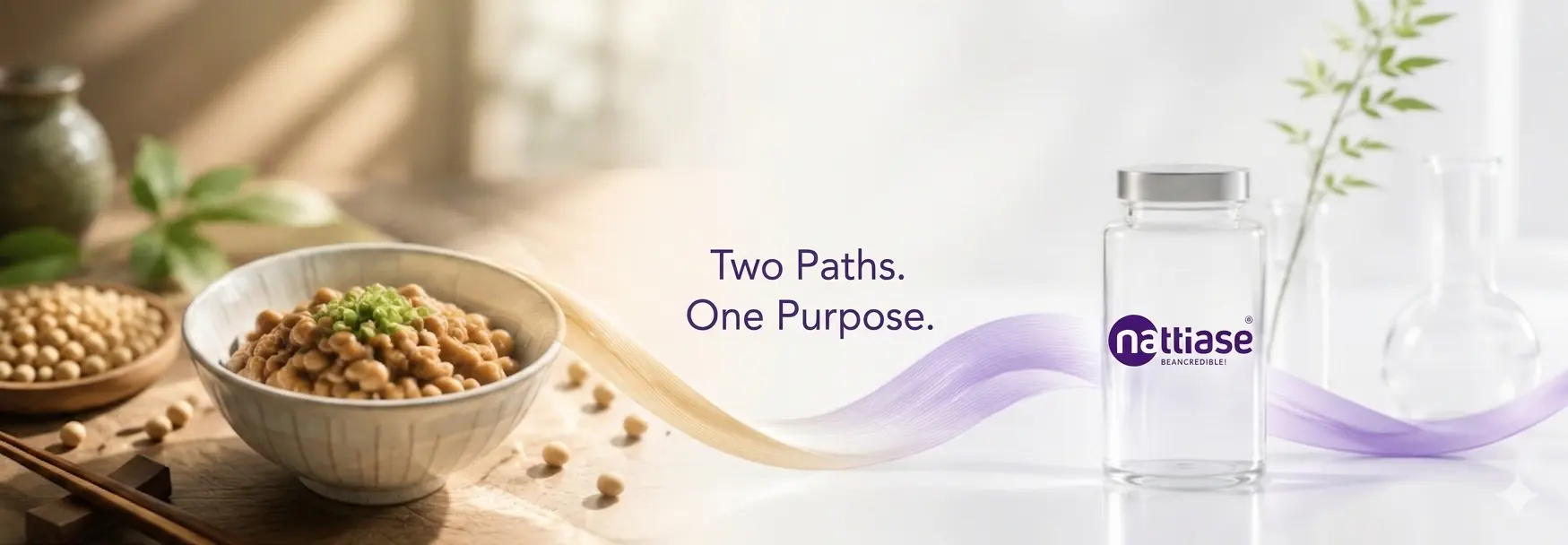
For centuries, Japanese consumers have obtained nattokinase naturally through natto. Today, standardized supplements provide another option for people who want predictable enzyme activity without significantly changing their dietary habits.
Neither approach is inherently superior. The decision often comes down to personal preference, accessibility, and consistency.
For individuals who enjoy fermented foods, natto remains a valuable traditional food. Beyond nattokinase, it also provides protein, vitamin K2, and other fermentation-derived nutrients. However, natto is equally known for its distinctive aroma, sticky texture, and strong flavor, characteristics that not everyone finds appealing.
Another practical consideration is that natto delivers a complete food matrix rather than nattokinase alone. For some individuals, this may be an advantage. For others, it may introduce considerations unrelated to nattokinase itself.
For example, natto contains purines, which may be relevant for individuals managing gout or elevated uric acid levels. It also contains naturally occurring soy isoflavones, which some consumers may prefer to monitor as part of their overall dietary strategy. These considerations do not make natto unhealthy, but they help explain why some people choose a standardized nattokinase supplement instead.
Supplements take a different approach. Rather than relying on natural variation in fermentation and food preparation, they are designed to provide a defined amount of nattokinase activity. This makes it easier to understand how much enzyme activity is being consumed and to maintain a consistent routine over time.
Why quality matters more than milligrams

One of the most common misconceptions is that a larger milligram number automatically means a better nattokinase product.
Nattokinase is an enzyme, and enzymes are defined by activity rather than weight alone. This is why fibrinolytic units (FU) have become the preferred way to evaluate nattokinase potency.
When comparing products, consumers should look beyond marketing claims and consider whether enzyme activity is clearly stated, whether stability has been validated, and whether quality testing is available.
A well-formulated nattokinase supplement should deliver consistent activity throughout its shelf life, not only on the day it leaves the factory. This is especially important because enzyme performance can be influenced by manufacturing conditions, storage environments, and formulation design.
If you are new to nattokinase, understanding FU activity, quality verification, and product stability can be just as important as understanding the ingredient itself.
Using nattokinase responsibly
Like any supplement intended for long-term wellness support, nattokinase should be used with realistic expectations.
Current research primarily explores nattokinase in relation to fibrinolysis-related biology, circulation, and vascular-support pathways. It should not be viewed as a replacement for prescribed therapies or as a shortcut to cardiovascular health.
People taking anticoagulants, antiplatelet medications, or preparing for surgery should consult a healthcare professional before use. Similar caution is recommended for pregnant women, breastfeeding mothers, children, individuals recovering from significant blood loss, and those with known bleeding risk.
Understanding these boundaries is part of responsible supplement use and reflects the same quality-first mindset that should guide product selection.
Practical reminders
- Follow product instructions consistently.
- Prioritize verified FU activity.
- Store products according to label recommendations.
- Consult healthcare professionals when appropriate.
Takeaway
Whether you prefer traditional natto or a standardized supplement, the goal remains the same: supporting a healthy lifestyle through informed decisions.
Natto offers a centuries-old food tradition, while nattokinase supplements provide convenience, consistency, and standardized activity. Understanding the differences between the two allows consumers to choose the option that best aligns with their individual needs.
Ultimately, the most important habit is not simply taking nattokinase. It is building a long-term approach to circulation, healthy aging, and overall wellness that can be maintained for years to come.
- Choose natto if you enjoy traditional fermented foods and can comfortably incorporate them into your diet.
- Choose supplements if you prefer convenience, consistency, and standardized FU activity.
- Prioritize quality, stability, and transparency for long-term daily use.
Related Articles

Essentials of Nattokinase
2026-04-20
What Causes Plaque Buildup? Understanding LDL, Triglycerides, and Where Nattokinase Fits
Plaque buildup is not just about “high cholesterol.” Learn how LDL, triglycerides, endothelial stress, and chronic inflammation shape atherosclerosis, and where nattokinase becomes relevant.
Read More
Essentials of Nattokinase
2026-05-18
What is metabolic health? Understanding glucose, lipids, and circulation
A clear framework of metabolic health, connecting glucose, lipids, circulation, and early metabolic imbalance.
Read More