
Essentials of Nattokinase
2026-05-18
What is metabolic health? Understanding glucose, lipids, and circulation
What metabolic health really means
Metabolic health is often defined by glucose or cholesterol levels. These markers reflect a broader system.
Circulation connects how nutrients are delivered and used. Imbalance develops across systems, not in isolation.
Understanding this framework helps interpret metabolic risk more accurately.
What metabolic health means: key markers and system balance
Metabolic health is often assessed through glucose, lipid profile, blood pressure, and central adiposity. These markers form the basis of metabolic syndrome definitions (Grundy et al., 2004), but they are best understood as system-level readouts rather than isolated variables.
For example:
- Glucose reflects short-term energy regulation
- Triglycerides reflect metabolic flux and storage dynamics
- Blood pressure reflects vascular tone and systemic resistance
Taken together, these markers describe how effectively the body maintains equilibrium under varying metabolic demands.
A key implication is that changes in one marker often reflect adjustments across the system rather than a single localized dysfunction.
How circulation supports glucose and lipid metabolism
Metabolic regulation depends not only on biochemical signaling, but also on physical delivery systems. Glucose uptake, for example, is often framed as an insulin-dependent process. However, insulin signaling operates at the cellular level, while circulation determines whether glucose actually reaches target tissues.
This introduces a two-layer model:
- Signaling layer: insulin response, receptor activity
- Delivery layer: blood flow, capillary perfusion
When circulation is efficient, these layers remain aligned. When circulation is impaired, signaling and delivery can become mismatched.
This mismatch may manifest as:
- Uneven glucose uptake between tissues
- Altered lipid redistribution
- Delayed metabolic clearance
Endothelial dysfunction, particularly in response to oxidized LDL, has been linked to early disruption of vascular regulation (Jiang et al., 2022), highlighting how vascular changes can precede or amplify metabolic imbalance.

Why triglycerides provide insight into metabolic dynamics
Triglycerides are often interpreted as a simple “lipid marker,” but they are more accurately understood as indicators of metabolic throughput.
They respond dynamically to:
- Dietary intake
- Hepatic lipid production
- Insulin signaling
- Clearance via circulation
Triglyceride-rich lipoproteins and their remnants are now recognized as active contributors to vascular and metabolic signaling (Ginsberg et al., 2021).
This means that elevated triglycerides may reflect:
- Increased substrate flux
- Impaired clearance
- Altered metabolic prioritization
rather than a single isolated abnormality.
Early metabolic imbalance: a system-level feedback model
Metabolic imbalance often develops through feedback loops:
- Glucose variability
- Hepatic lipid production
- Increased circulating triglycerides
- Vascular stress
- Altered perfusion
- Further metabolic dysregulation
Importantly, this loop does not require overt disease to be active. It may exist at a subclinical level, contributing to gradual shifts in metabolic stability.
Evidence snapshot: metabolic markers and circulation
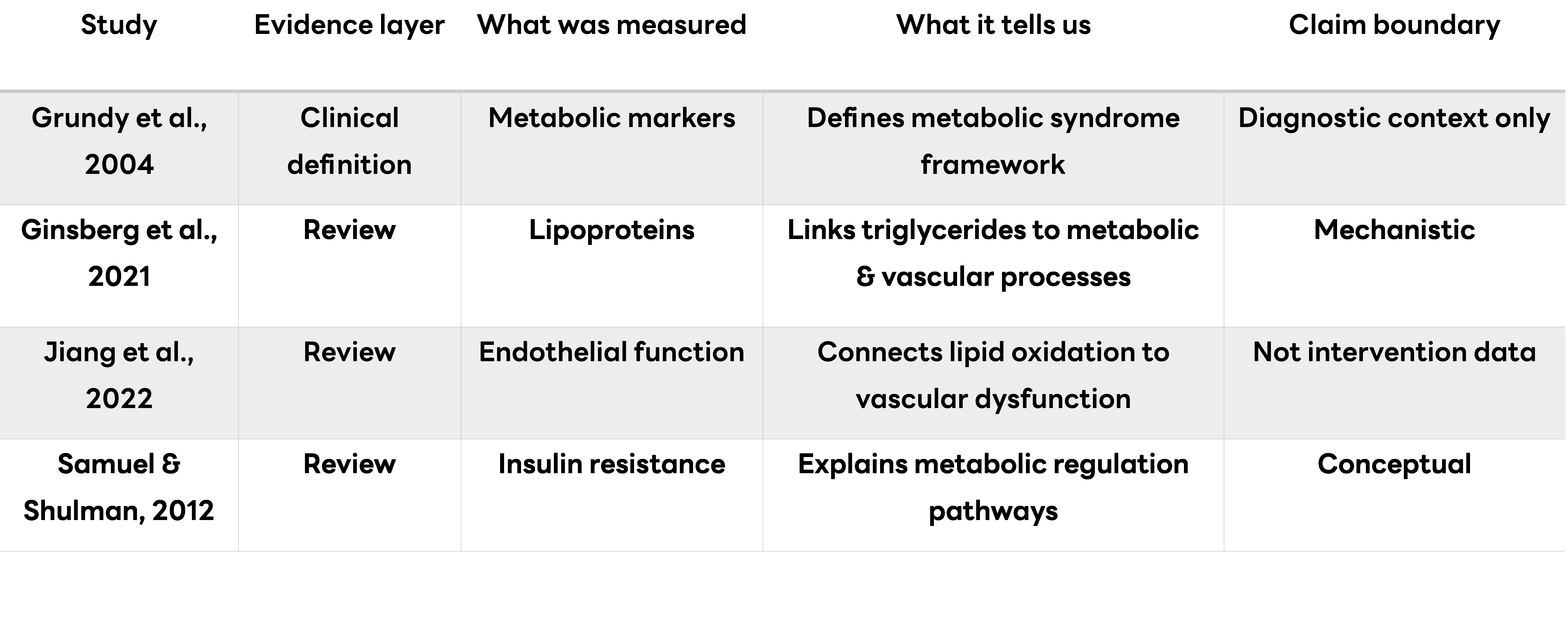
Mechanism: metabolism as a circulation-dependent system
A more complete model of metabolic regulation includes both signaling and transport:
- Nutrient intake
- Hormonal signaling (insulin, glucagon)
- Circulation-mediated delivery
- Tissue uptake
- Intracellular metabolism
- Systemic feedback
When circulation becomes limiting:
- Tissue-level heterogeneity increases
- Metabolic efficiency decreases
- Compensatory signaling intensifies
This perspective helps explain why metabolic markers can diverge even when traditional regulatory pathways appear intact.

From metabolic health to circulation-based approaches
Understanding the system provides context for how different interventions are studied.
Some approaches focus on glucose regulation or lipid metabolism directly. Others are studied at the level of circulation and vascular processes.
For a detailed explanation of how nattokinase fits into metabolic health—including its relationship with lipids, circulation, and glucose balance:
Read more:
Nattokinase for metabolic health: lipids, circulation, and glucose balance
FAQ
How can glucose regulation appear normal while metabolic imbalance is already developing?
Glucose levels represent a tightly regulated endpoint. The body can compensate through increased insulin secretion, hepatic adjustments, or altered tissue uptake. As a result, glucose may remain within normal ranges while underlying processes—such as lipid metabolism or vascular function—are already shifting.
Why are triglycerides considered more “dynamic” than cholesterol?
Triglycerides respond rapidly to metabolic inputs, including diet and insulin signaling. In contrast, cholesterol is more structurally regulated. This makes triglycerides more sensitive to short-term metabolic changes, but also more variable and context-dependent.
What role does microcirculation play in metabolic health?
Microcirculation determines how nutrients are distributed at the tissue level. Even if large-vessel circulation appears normal, impaired capillary perfusion can lead to uneven nutrient delivery, which may affect metabolic efficiency at the cellular level.
Can vascular changes precede metabolic dysfunction?
Emerging evidence suggests that endothelial dysfunction can occur early and may influence how metabolic processes are expressed across tissues (Jiang et al., 2022). However, these relationships are bidirectional and context-dependent.
References
Published references
- Grundy SM, Brewer HB Jr, Cleeman JI, et al. Definition of metabolic syndrome: report of the National Heart, Lung, and Blood Institute/American Heart Association conference. Circulation. 2004;109(3):433–438. doi:10.1161/01.CIR.0000111245.75752.C6
- Ginsberg HN, Packard CJ, Chapman MJ, et al. Triglyceride-rich lipoproteins and their remnants: metabolic insights, role in atherosclerotic cardiovascular disease, and emerging therapeutic strategies. Eur Heart J. 2021;42(47):4791–4806. doi:10.1093/eurheartj/ehab551
- Jiang H, Zhou Y, Nabavi SM, et al. Mechanisms of oxidized LDL-mediated endothelial dysfunction and its consequences for the development of atherosclerosis. Front Cardiovasc Med. 2022;9:925923. doi:10.3389/fcvm.2022.925923
- Li X, Long J, Gao Q, et al. Nattokinase Supplementation and Cardiovascular Risk Factors: A Systematic Review and Meta-Analysis of Randomized Controlled Trials. Rev Cardiovasc Med. 2023;24(8):234. doi:10.31083/j.rcm2408234
- Samuel VT, Shulman GI. Mechanisms for insulin resistance: common threads and missing links. Cell. 2012;148(5):852–871. doi:10.1016/j.cell.2012.02.017
Related Articles

Essentials of Nattokinase
2026-02-19
Blood Flow & Thrombosis Fundamentals: How Circulation Works and Where Nattokinase Fits
Learn how blood flow works, what thrombosis is, how clots disrupt circulation, and where nattokinase fits in the evidence around fibrinolysis and vascular support.
Read More
Essentials of Nattokinase
2026-04-20
What Causes Plaque Buildup? Understanding LDL, Triglycerides, and Where Nattokinase Fits
Plaque buildup is not just about “high cholesterol.” Learn how LDL, triglycerides, endothelial stress, and chronic inflammation shape atherosclerosis, and where nattokinase becomes relevant.
Read More