
Essentials of Nattokinase
2026-04-20
What Causes Plaque Buildup? Understanding LDL, Triglycerides, and Where Nattokinase Fits
At a glance
Plaque buildup does not happen because fat simply “sticks” to an artery wall.
It develops over time through a chain that involves atherogenic lipoproteins, endothelial stress, immune activity, and chronic inflammation.
This is why LDL and triglycerides both matter, but not in the same way.
It also explains why nattokinase belongs in a vascular-support conversation rather than a simple cholesterol-lowering narrative.
A responsible article should clarify that relevance without turning nattokinase into a stand-alone solution for atherosclerosis.
What Atherosclerotic Plaque Actually Is
Atherosclerosis is the gradual buildup of plaque inside the walls of arteries. That plaque is not made of one thing alone. It can include cholesterol-rich material, inflammatory cells, connective tissue, and cellular debris that accumulate over time.
The process usually begins earlier than most people realize. Certain lipoproteins enter the arterial wall and become retained there. Once that happens, the local environment can shift. The endothelium becomes more vulnerable, inflammatory signaling increases, and immune cells begin to gather. Over time, this can turn an early lesion into a more established plaque.
Why Plaque Is More Than “High Cholesterol”
The plaque story should not be reduced to a single sentence about “high cholesterol.” Cholesterol matters, but plaque formation is better understood as a multi-step vascular process.
Atherogenic particles, endothelial dysfunction, inflammatory signaling, and immune-cell activity all help shape how plaque develops over time.
Where LDL and Triglycerides Begin to Diverge
LDL and triglycerides are often grouped together because both appear on a lipid panel, but they do not mean the same thing.
LDL is more directly tied to cholesterol-carrying particles involved in plaque formation. Triglycerides, by contrast, often reflect a broader cardiometabolic pattern that may involve triglyceride-rich lipoproteins, remnant particles, and residual cardiovascular risk.
Nattokinase becomes relevant within that broader vascular context. It is not best understood as a classic cholesterol ingredient. Its more defensible place is in the conversation around circulation, fibrin-related biology, and vascular support.

Why Plaque Buildup Matters Even Before Symptoms Appear
Plaque buildup is often silent. People may feel well for years while atherosclerosis continues to develop in the background. By the time symptoms appear, the underlying process may already be well established.
Readers often come in with an oversimplified question. They want to know how to lower cholesterol and triglycerides, but that is not quite the same as understanding why plaque forms. A more useful article helps the reader see the full picture: lipoprotein retention, endothelial dysfunction, inflammation, and vascular remodeling are all part of the story.
The Silent Nature of Atherosclerosis
Atherosclerosis often develops gradually and quietly. That is one reason simplified content can be misleading.
If readers assume plaque is only a short-term reaction to one bad number, they miss the long-term nature of vascular change.
Why an Ingredient-Only Explanation Is Not Enough
Plaque biology involves LDL-related exposure, endothelial stress, chronic inflammation, metabolic context, and broader cardiovascular risk patterns.
That is why nattokinase should be introduced carefully. It can be relevant in a vascular-support discussion, but it should not be framed as though it explains or resolves the entire plaque story by itself.
What the Evidence Shows So Far
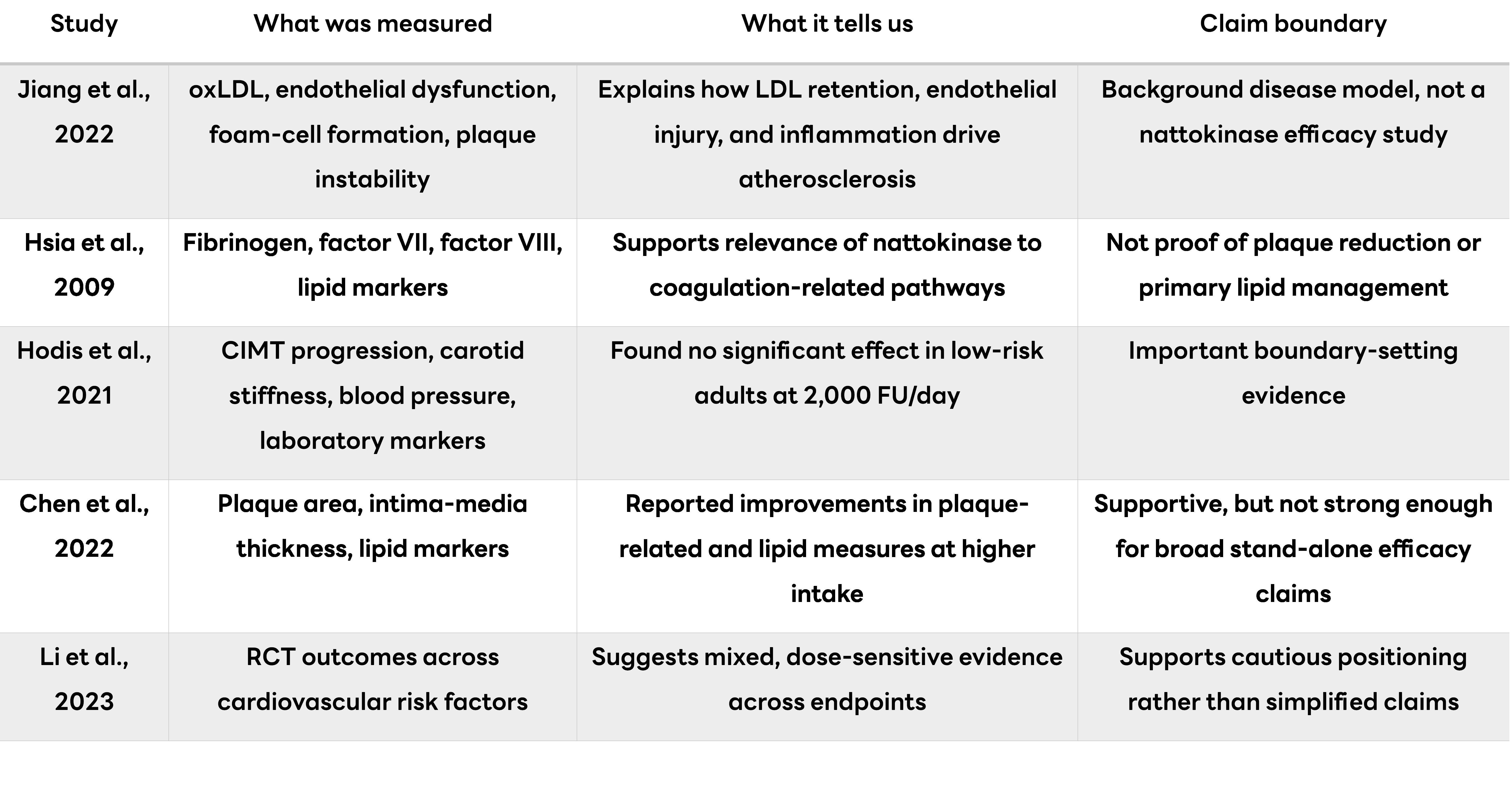
The evidence is most useful when read in layers. Some papers clarify how plaque forms. Others look at vascular or coagulation-related biomarkers. Some examine plaque-related imaging or surrogate cardiovascular measures. Together, they support relevance, but they do not justify exaggerated claims.
What Disease-Mechanism Papers Help Explain
Mechanistic papers help explain why plaque buildup is more than a simple cholesterol topic.
They support the educational foundation of the page, but they do not function as direct nattokinase efficacy proof.
What Human Nattokinase Studies Can and Cannot Support
Human studies support the relevance of nattokinase to vascular or coagulation-related endpoints, but the evidence is not uniform.
There is enough evidence to justify discussing nattokinase in relation to vascular support and atherosclerosis-related biology. There is not enough evidence to collapse that discussion into “proven plaque reversal” or “natural replacement for lipid drugs.”

How Plaque Forms: A Simple Mechanism Map
A useful way to explain plaque buildup is to show the chain clearly:
Atherogenic lipoproteins enter the arterial wall → retention and modification increase → endothelial stress rises → immune cells are recruited → foam cells form → chronic inflammatory signaling continues → plaque develops and may become unstable
Triglycerides fit into the story differently:
Higher triglycerides often reflect triglyceride-rich lipoproteins and remnant exposure → additional metabolic and inflammatory burden → added cardiovascular risk alongside the LDL-driven plaque pathway
Nattokinase fits through a separate lane:
Nattokinase → fibrin-related biology and circulation-oriented relevance → interest in vascular-support contexts → possible relevance to the broader vessel environment
FAQ
Q: What causes plaque buildup in arteries?
A: Plaque buildup is driven by more than one factor. LDL-related particle retention, endothelial dysfunction, chronic inflammation, immune-cell activity, and vascular remodeling all contribute to the process.
Q: Is plaque just cholesterol?
A: No. Cholesterol is part of plaque, but plaque formation also involves inflammation, vascular injury, immune signaling, and structural changes in the arterial wall.
Q: What is the difference between LDL and triglycerides?
A: LDL refers to cholesterol-carrying lipoproteins more directly tied to plaque formation. Triglycerides are a form of fat used for energy and often point to triglyceride-rich lipoproteins, remnant particles, and broader metabolic risk.
Q: Does nattokinase lower cholesterol?
A: It is better not to position nattokinase as a primary cholesterol-management ingredient. Its more defensible role is in circulation- and vascular-support discussions, with mixed human evidence on lipid endpoints.
Q: Can nattokinase reverse atherosclerosis?
A: That is too strong a conclusion. The evidence can support scientific relevance in atherosclerosis-related discussions, but not a broad stand-alone claim that nattokinase reverses plaque.
Related Reading
Readers who want a closer look at plaque-specific evidence can continue with Breaking Down Arterial Plaque: What New Nattokinase Research Reveals. For more context on the inflammatory side of vascular health, An Elemental Miracle for Reducing Vascular Inflammation, Chronic Inflammation: Facts vs Fiction, Inflammation: The Silent Enemy Within, and Nattokinase Endothelial Inflammation Study help widen the picture. For readers approaching the topic from blood lipids or broader metabolic balance, Nattokinase for Metabolic Health Support: Lipids, Circulation & Glucose Balance is the natural next read.
References
Published references
Jiang H, Zhou Y, Nabavi SM, et al. Mechanisms of Oxidized LDL-Mediated Endothelial Dysfunction and Its Consequences for the Development of Atherosclerosis. Front Cardiovasc Med. 2022;9:925923.
Hsia CH, Shen MC, Lin JS, et al. Nattokinase decreases plasma levels of fibrinogen, factor VII, and factor VIII in human subjects. Nutr Res. 2009;29(3):190-196.
Hodis HN, Mack WJ, Azen SP, et al. Nattokinase atherothrombotic prevention study: A randomized controlled trial. Clin Hemorheol Microcirc. 2021;78(4):339-353.
Chen H, Chen J, Zhang F, et al. Effective management of atherosclerosis progress and hyperlipidemia with nattokinase: A clinical study with 1,062 participants. Front Cardiovasc Med. 2022;9:964977.
Li X, Long J, Gao Q, et al. Nattokinase Supplementation and Cardiovascular Risk Factors: A Systematic Review and Meta-Analysis of Randomized Controlled Trials. Rev Cardiovasc Med. 2023;24(8):234.
Ginsberg HN, Packard CJ, Chapman MJ, et al. Triglyceride-rich lipoproteins and their remnants: metabolic insights, role in atherosclerotic cardiovascular disease, and emerging therapeutic strategies. Eur Heart J. 2021;42(47):4791-4806.
Clinical guidance sources
CDC. LDL and HDL Cholesterol and Triglycerides.
American Heart Association. Understanding Cholesterol and Lipids.
American Heart Association. Lifestyle Changes to Prevent a Heart Attack.
Related Articles

Essentials of Nattokinase
2026-02-19
Blood Flow & Thrombosis Fundamentals: How Circulation Works and Where Nattokinase Fits
Learn how blood flow works, what thrombosis is, how clots disrupt circulation, and where nattokinase fits in the evidence around fibrinolysis and vascular support.
Read More
Essentials of Nattokinase
2026-05-18
What is metabolic health? Understanding glucose, lipids, and circulation
A clear framework of metabolic health, connecting glucose, lipids, circulation, and early metabolic imbalance.
Read More